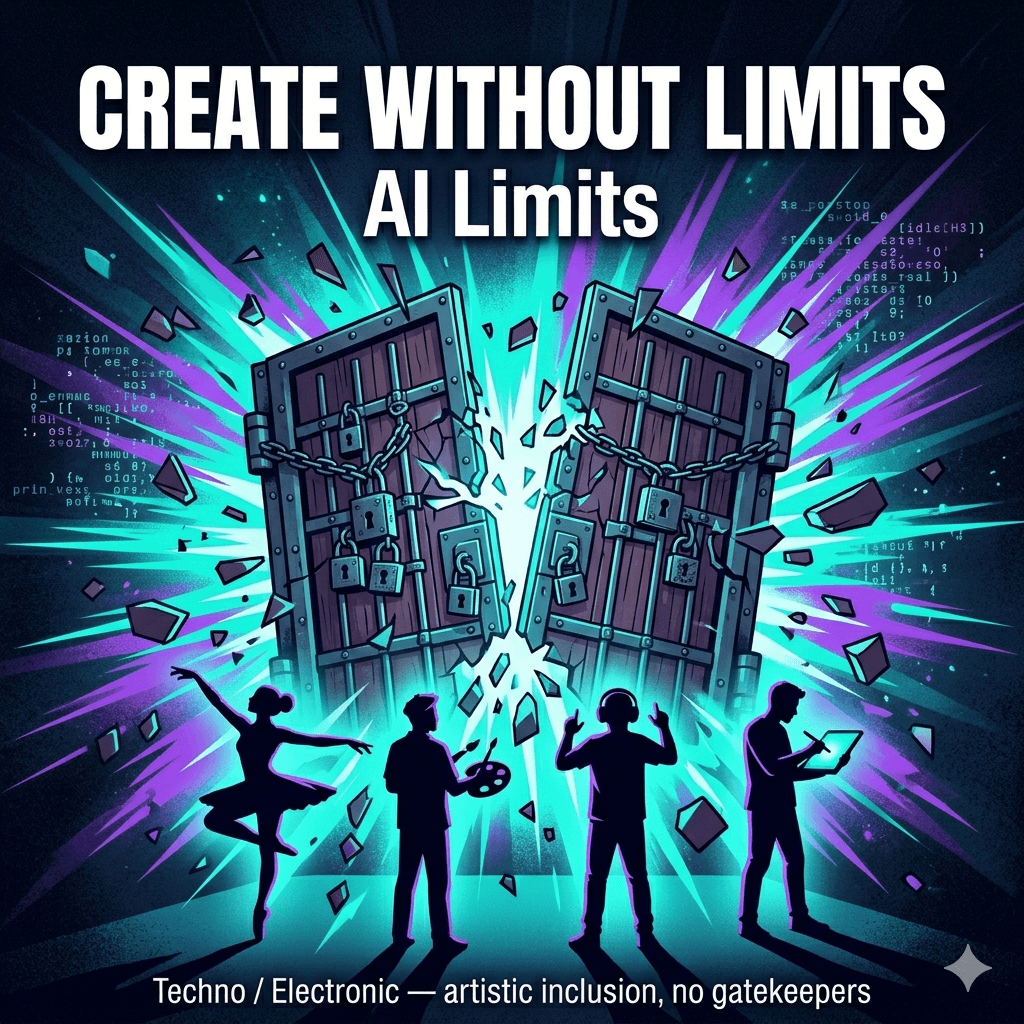
Citizen-Level Intelligence — AI That Works for Everyone, Not Just Engineers
The promise was democratized intelligence. The reality is a professional tool that requires professional skill. Closing that gap is a structural governance challenge — and it starts with designing for the citizen, not the power user.
When quantum physicists discovered tunneling — the phenomenon where a particle passes through a barrier it classically shouldn’t be able to cross — they didn’t revise the particle. They revised the model. The particle was always capable. The barrier was never what classical physics said it was. The math just hadn’t caught up.
AI accessibility has the same structure. The people are capable. The barriers are artificial. And the systems haven’t caught up.
The Access Problem
Go to any major AI platform right now. Try to use it well without a background in software engineering, prompt design, or technical product management. You’ll get a text box. Maybe a sidebar with some settings. Temperature, top-p, system instructions — terms that mean nothing to a teacher in Brampton, a social worker in Winnipeg, or a small business owner in Québec City.
The interface says: this is for you. The experience says: this is for engineers.
This is the citizen gap. AI companies market their products as universal tools while building interfaces that require specialist knowledge to use effectively. The tools are nominally accessible — anyone can type a prompt — but functionally exclusive. The quality of the output scales with the user’s technical sophistication. A senior developer gets brilliant results. A citizen gets mediocre ones. Same model, same price, wildly different value.
The industry treats this as a user education problem. “People need to learn prompt engineering.” That’s like saying people need to learn SQL before they can use a search engine. The problem isn’t the user’s skill. The problem is the system’s design.
Tunneling Through the Barrier
In quantum mechanics, tunneling doesn’t mean the barrier disappears. The barrier is still there. But the particle’s wave function extends through it — there’s a non-zero probability of appearing on the other side. The governing equations allow passage that classical mechanics prohibits.
Governed AI accessibility works the same way. You don’t remove the complexity of AI. You build a system that carries people through it. The complexity is still there — the models, the parameters, the context management, the safety constraints — but the governance layer handles it so the user doesn’t have to.
This is what a tier system should do. Not gate features behind paywalls (though sustainability requires revenue). Gate complexity behind governed progression. An observer — someone who’s just looking — sees a clean, simple interface with transparent disclosures. A citizen — someone who’s committed to engaging — sees more capability, but with guardrails that prevent the system from producing harmful or unreliable output. A scholar gets deeper access, but only after demonstrating understanding of what that access means.
The tier system isn’t about charging more for better AI. It’s about matching system capability to user readiness. The model is the same at every level. What changes is the governance: how much context is managed automatically, how much the user must provide, how much risk the system absorbs versus how much it surfaces for explicit human decision.
The Canadian Question
I’m building this in Canada, and that’s not incidental.
Canada has 40 million people. We don’t have the compute infrastructure of the United States. We don’t have the regulatory apparatus of the EU. We don’t have the surveillance architecture of China. What we have is a service delivery challenge that’s instructive: how do you provide intelligent digital services across the second-largest country on earth, in two official languages, across wildly different urban and rural contexts, with a fraction of the resources available to larger nations?
The answer isn’t “build bigger models.” Canada will never outspend the US on compute. The answer is “build better systems.” Use governed routing to send requests to appropriately-scoped models. Use the tier system to match governance to stakes. Use Intelligence Scholarship to ensure the people operating the system understand what they’re holding.
This is where quantum tunneling stops being a metaphor and starts being an engineering blueprint. The barrier is resource constraint. The wave function that extends through it is governance — structural design that makes intelligence accessible without requiring everyone to become an engineer first.
Intelligence Scholarship as Tunneling Infrastructure
I mentioned Intelligence Scholarship in Part 1. It’s the education layer we’re building: Foundation, Advanced, Doctoral. Curriculum modules on ethical AI governance, deliberation engine design, sovereignty and principal hierarchies.
This sounds academic. It’s not. It’s tunneling infrastructure.
Here’s the problem: if you give everyone access to the most powerful AI capabilities with no preparation, bad things happen. Not because people are bad, but because powerful tools used without understanding cause harm as reliably as power tools used without safety training. The industry’s answer is either “restrict access” (which creates the citizen gap) or “give everyone everything and hope for the best” (which creates the harm).
Intelligence Scholarship is a third option: make the understanding part of the access path. Not as a barrier — as a bridge. Each level of understanding unlocks corresponding capability. The citizen who completes Foundation understands accountability stacks and decision provenance. They know what the system is doing and why. They’re equipped to use more powerful features not because they’ve passed a test, but because they’ve internalized the structural concepts that make those features safe.
The tunnel isn’t “contact sales” or “pay more.” The tunnel is understanding. The governed system allows passage because the user has earned it — not with money, but with demonstrated comprehension of what they’re accessing.
The Pathway Architecture
Access isn’t one-size-fits-all. A journalist needs different governance than a developer. A student needs different governance than an enterprise client. A citizen exploring AI for the first time needs different governance than a researcher running fine-tuning experiments.
We’ve built this as a pathway system. Each pathway defines what the person sees, what’s withheld, what conditions apply, and what clearance floor is required. A news and media pathway gets transparent, citable information with clear attribution. A mentorship pathway gets deeper methodology access but requires a cognitive waiver — an acknowledgment that the material may challenge assumptions. An external test pathway gets live system access with real billing because testing isn’t free and pretending it is creates misaligned expectations.
Each pathway is its own tunnel through the complexity barrier. The governance system doesn’t need to know whether the person is technical. It needs to know what state they’re in, what they’re trying to do, and what structural requirements apply to that interaction.
What Citizen-Level Intelligence Actually Means
It means a teacher in Brampton can use AI to generate culturally appropriate lesson plans for a multilingual classroom — without learning prompt engineering. Because the governance layer manages context, the tier system matches capability to stakes, and the system doesn’t assume the user is an engineer.
It means a small business owner in Rimouski can get AI-assisted financial projections in French that account for Canadian tax structure — without an enterprise contract. Because the governed routing sends the request to an appropriately-scoped model at a cost that works at $15 a month.
It means a first-generation university student can access AI tutoring that adapts to what they actually understand — not what the system assumes they should know. Because Intelligence Scholarship provides the structural education that turns passive consumption into active understanding.
Citizen-level intelligence isn’t a feature. It’s a design philosophy. The intelligence is in the system — in the tiers, the governance, the scholarship, the pathways, the ethical weighting that scales with stakes. The model is the engine. The system is the vehicle. And a vehicle is only as useful as the roads, the signs, the rules, and the infrastructure that make it safe for anyone to drive.
Closing the Series
Part 1 established that intelligence is a system property, not a model property. Superposition shows us that AI outputs are selected, not inevitable. Quanta shows us that there are irreducible governance requirements for intelligent operation.
Part 2 showed that training decisions are permanently entangled with deployment outcomes. You can’t govern one without the other. The five ethical dimensions of Attention Wave provide a structural framework for weighing training decisions against the stakes they affect.
Part 3 — this article — argues that accessibility isn’t a feature to be bolted on after the system works. It’s a governance principle that must be embedded in the architecture from the start. Quantum tunneling is the model: governed systems allow passage through complexity barriers that unstructured systems can’t.
Together, Quanta Systems describes a framework where intelligence isn’t something you buy from an API. It’s something you build — structurally, ethically, and for everyone.
The fundamental unit of intelligence isn’t the parameter. It’s the governed decision. And that’s a unit that belongs to all of us.
You’re reading 3 of 5.
Get notified when the next article drops. No marketing — one email per new article, unsubscribe any time.